












Clean indoor air
Genano’s IoT-based indoor air quality monitoring
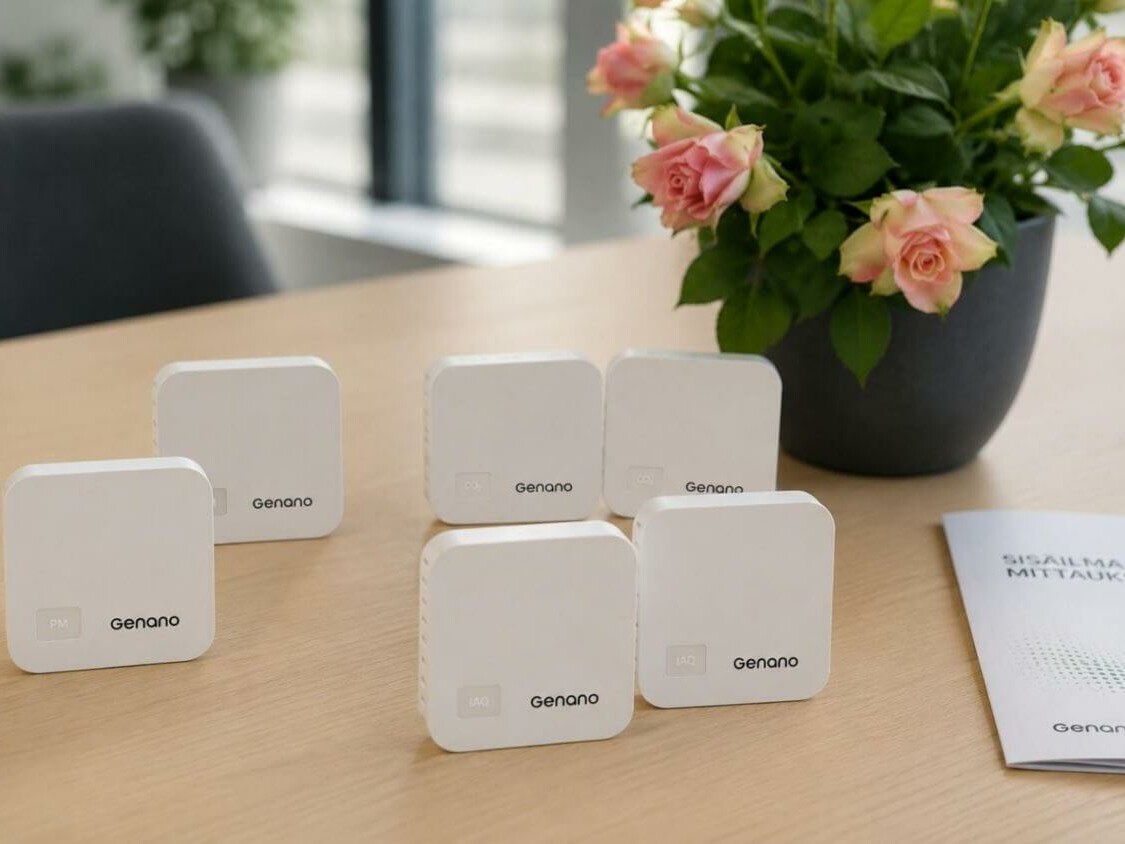
Good decisions start with reliable measurements. Genano’s IoT-based monitoring provides real-time information about conditions in your building and helps identify factors that may affect indoor air quality. The data helps you decide where to investigate and what action to take.
Real-time monitoring also helps building owners, facilities teams and other decision-makers respond quickly when conditions change. You can spot changes early, act in time and check whether the measures are working.
What can Genano’s IoT service monitor?
The service measures indoor air quality and building conditions in real time. You can track changes, identify unusual readings and make informed decisions.
Key indoor air quality parameters include:
TVOC measurements track the combined concentration of volatile organic compounds in the air.
Typical reasons to measure TVOC include:
- Unusual odours in the building.
- Reports of eye, nose or respiratory irritation.
- Recent refurbishment or new construction materials or furnishings.
The data helps you identify unusual VOC concentrations and track them over time.
When it can help: TVOC monitoring is often used to investigate unusual odours, irritation of the eyes, nose or throat, headaches or a feeling that the air is stuffy.
Particle measurements track fine particles and dust in the air.
Typical reasons to measure particles include:
- More dust than usual indoors.
- Nearby traffic, construction or other activities that generate particles.
- A need to assess the effects of air purification or other measures.
The data shows how particle concentrations vary and how they change after action is taken.
When it can help: Measurements can help assess whether reports of dust or respiratory irritation coincide with elevated particle concentrations.
Carbon dioxide measurements provide information about ventilation and occupancy.
Typical reasons to measure CO₂ include:
- Spaces are fully occupied at certain times.
- The air feels stuffy.
- You want to assess how ventilation performs under different conditions.
The data helps you assess whether ventilation is adequate for how the space is used.
When it can help: CO₂ readings can help assess whether fatigue or a feeling of stuffiness may be associated with insufficient ventilation.
Temperature measurements track how warm or cool the indoor environment is.
Typical reasons to monitor temperature include:
- Occupants feel too warm or too cold.
- Occupants have given feedback about indoor conditions.
- You want to track seasonal changes.
The data helps you assess whether temperatures remain stable and comfortable.
Humidity measurements track the relative humidity of indoor air.
Typical reasons to monitor humidity include:
- The air feels dry.
- You want to track how conditions change throughout the year.
- Humidity monitoring forms part of a wider indoor air quality programme.
The data helps you assess whether relative humidity stays within a suitable range.
Differential pressure measurements track pressure differences across the building envelope or between spaces.
Typical reasons to measure differential pressure include:
- Uncontrolled air leakage is suspected.
- Odours travel from one space to another.
- You want to check airflow direction after remedial work.
The data helps you assess how air moves through the building and whether pressure differences remain stable.
A browser-based dashboard gives you access to measurement and monitoring data from anywhere, at any time. You can view live readings and 24-hour median values to help identify meaningful changes. Building owners, facilities teams, indoor air quality working groups and others can use the same data to inform their decisions.
How do measurements support decisions?
Indoor air quality issues can have several causes, which can be difficult to identify through observations alone. Real-time readings help build a picture of conditions across the building and show which spaces or patterns warrant further investigation.
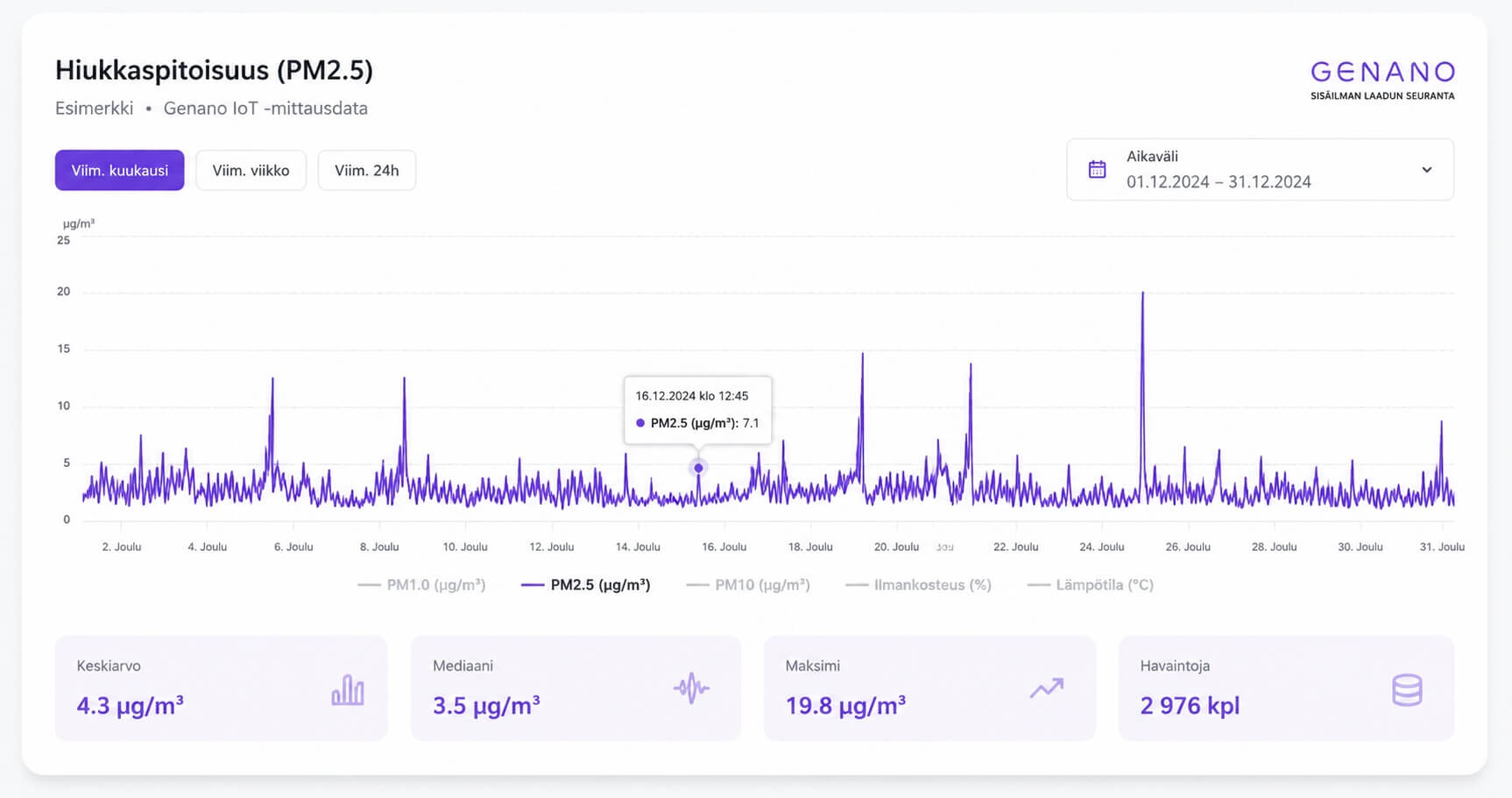
Measurements also help verify the impact of corrective measures and support decisions by building owners, facilities teams and indoor air quality working groups. With up-to-date data, you can respond promptly to unusual readings and use the evidence to guide improvements.
How Genano’s IoT service works
Site assessment
We design the monitoring system around how the building and its spaces are used and what you want to achieve, so you get data relevant to your decisions.
Measurement and monitoring
IoT sensors continuously collect indoor air quality data. The browser-based dashboard shows real-time results and trends based on 24-hour median values.
Data analysis
Measurements help identify unusual readings, track trends and decide where to focus follow-up work.
Decision support
Monitoring data supports building owners, facilities teams and others involved in decisions. It helps them target measures effectively and assess the results.
Continuous improvement
Ongoing monitoring helps verify the effects of improvements, respond to changes early and manage indoor air quality over the long term.
Typical applications
- Schools
- Nurseries
- Municipal facilities
- Hospitals
- Wellbeing services counties
- Parishes
Would you like to improve indoor air quality in your building?
Every building is different. Get in touch to discuss your needs and design a monitoring system that gives you the data you need to make informed decisions.

Olli Mandelin
Area of expertise: businesses, municipalities and wellbeing services counties
olli.mandelin@genano.fi
+358 50 5425 719

Clean indoor air
A service tailored to your needs
Every site and application is different. That’s why we offer several ways to procure Genano solutions and tailor each package to your needs, goals and budget.
We tailor every option to the site. Annual servicing can be included, and the contract term can be adapted to your needs. This gives you a solution that works today and can adapt as your needs change.
Clean indoor air as a service is ideal if you want a straightforward setup without a large upfront investment.
The service can include annual maintenance, or you can arrange servicing separately. We tailor each agreement to how the equipment will be used on site.
Leasing is suitable when you know you’ll need air purification over a longer period and want predictable costs throughout the contract.
A fixed-term lease can include annual servicing, or servicing can be arranged separately. We work with several leasing partners to find the right financing option for your site.
You can buy the air purifiers outright if you need them long term and want the equipment to become part of the building’s own assets.
New air purifiers come with a two-year manufacturer’s warranty. Annual servicing and any other maintenance can be arranged under a separate service agreement.
Rental is a good option when you need air purification for a shorter period or want to assess your needs before making a longer commitment.
The rental agreement can include annual servicing, or servicing can be arranged separately. The contract term and any notice period are agreed for each site.